Terminale · Axis 6 · B1–B2 · Go further
Who gets to be English?
A session to go further, after “Four Nations, One Kingdom?”
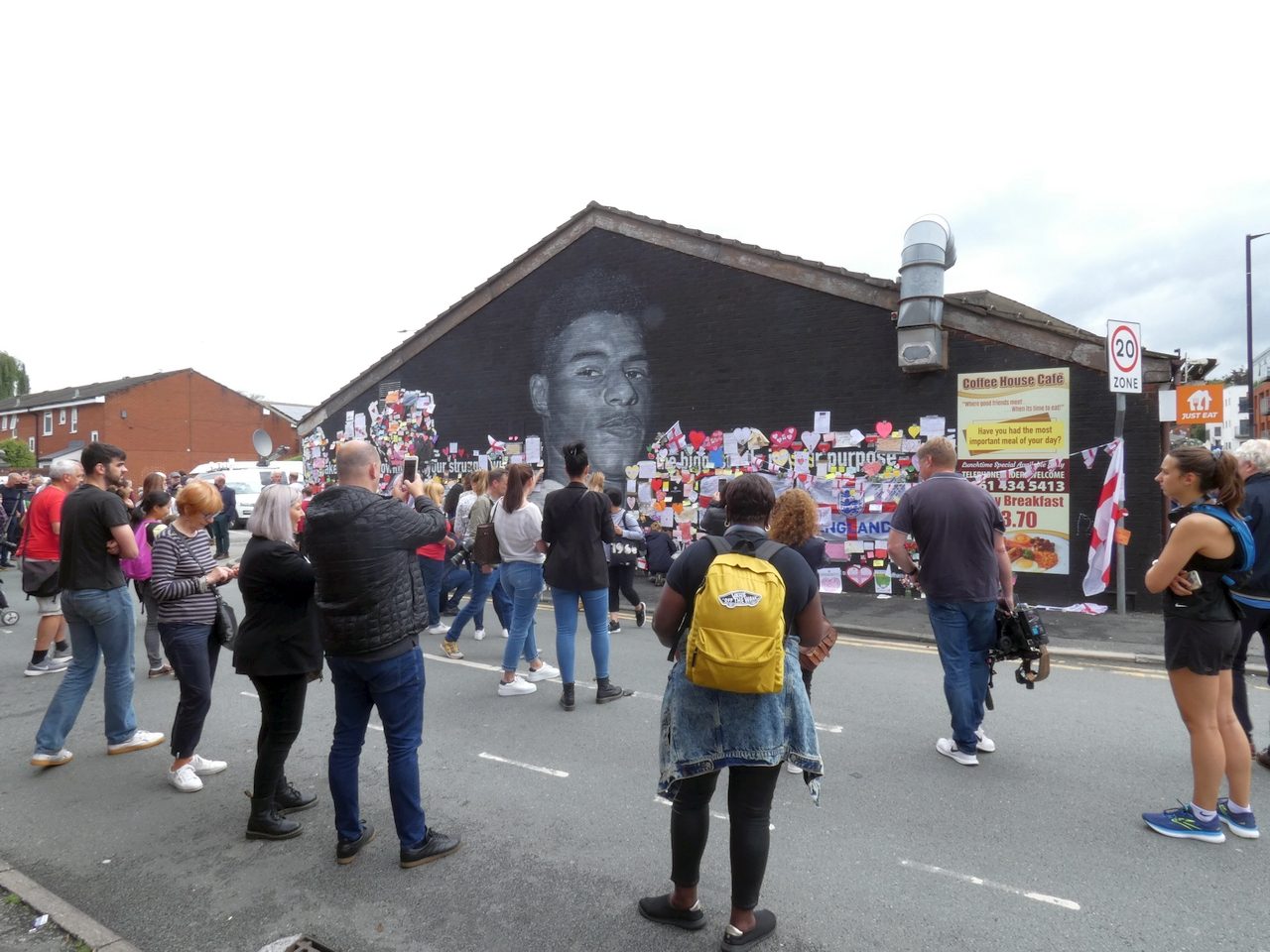
Messages of support on the Marcus Rashford mural, Copson Street, Withington, Manchester, 13 July 2021 · Photo: Gerald England, CC BY-SA 2.0, via Wikimedia Commons (resized) · Mural by the street artist Akse P19 (2020), with Withington Walls.

Message to share with the class
Why this session
Since the summer of 2025, English flags have gone up all over the country. They hang from windows and lampposts, and some have even been painted on roundabouts. Some people see pride in them, others see a warning. Our students scroll past these pictures every day, and nobody really explains them.
This session is not a debate for or against immigration. It starts from a question students already live with, in class, in a team or in a group of friends: who belongs, and who decides?
Plato, 2,400 years ago
In The Republic, Plato suggests telling citizens that they were all born from the same earth, with gold, silver or bronze in their souls. He calls this a “noble lie” himself. Every nation has a founding story of this kind, so it is worth asking who tells it, and who is left out.
Plato also describes prisoners who take shadows on a cave wall for the real world. For many of us today, that wall is a phone screen. Getting out of the cave means checking dates, reading documents and looking at real people.
Plato also says a city exists because nobody can live alone. The Windrush makes the same point: in 1948 the ship brought men and women from the Caribbean to help rebuild a Britain that badly needed workers.
How the session works
We start from Marcus Rashford’s mural in Manchester. After the Euro 2020 final in 2021, Rashford received racist abuse online, and his mural was covered with messages of support. From there we ask a simple question, what makes someone part of a group? We look at how Plato answered it, and then come back to today.
Students can see why they are studying this. A news story from England becomes a human question they will meet again, in any subject.
No final answer
The session doesn’t give one. It shows that the British themselves disagree about their own symbols. We work only on documents and public figures, never on students’ own identities.
Level
Terminale, general track, B1 to B2. It extends axis 6 of the curriculum, and it also works as a stand-alone lesson.
Madame Carole Paoli Pompougnac
The session, step by step
Step 1 · The fact
A mural in Withington, July 2021
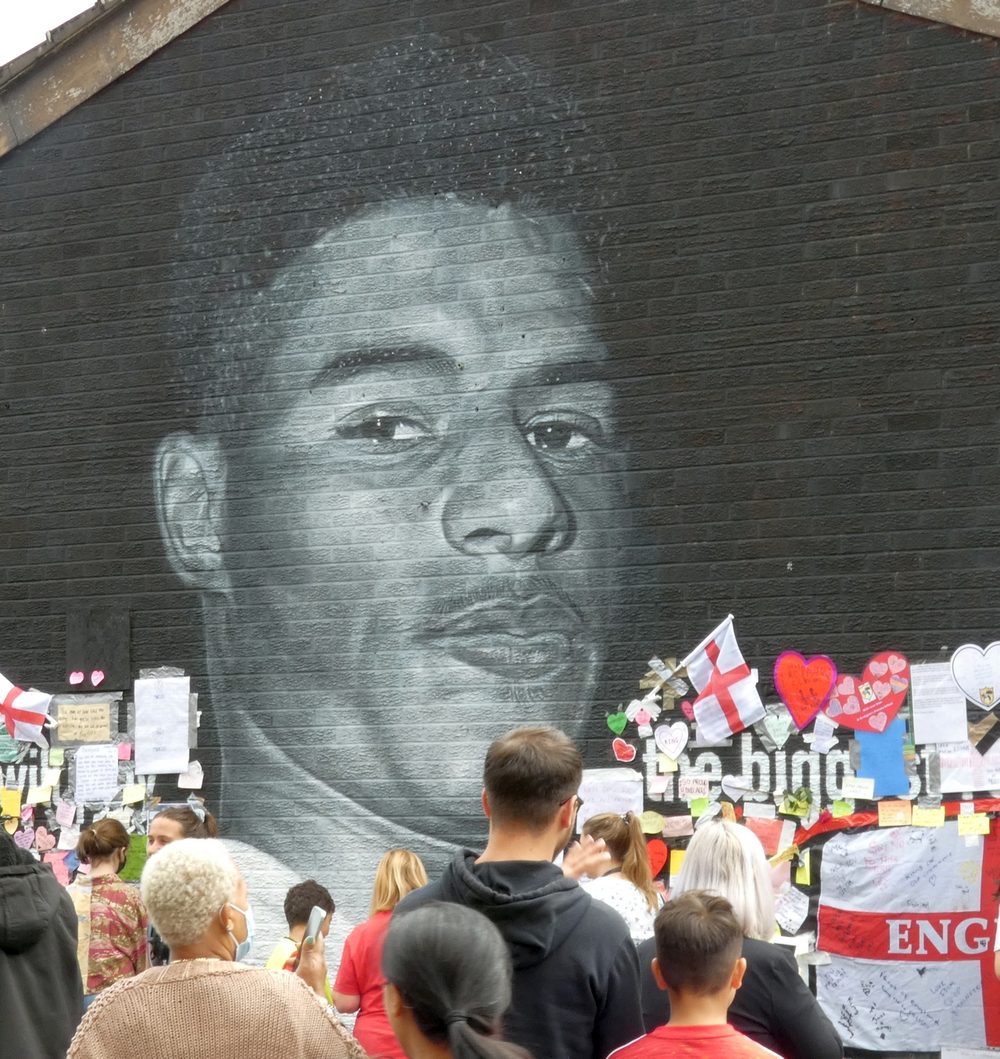
In 2020, the street artist Akse painted a mural of the footballer Marcus Rashford on the wall of the Coffee House Cafe, on Copson Street in Withington, the part of Manchester where Rashford grew up. It was painted in recognition of his work to tackle child food poverty. The quote on the mural comes from his mother: “Take pride in knowing that your struggle will play the biggest role in your purpose.”
On 11 July 2021, England lost the Euro 2020 final to Italy in a penalty shootout. Marcus Rashford, Jadon Sancho and Bukayo Saka missed their penalties. All three players were targeted with racist abuse on social media. That night, the mural was defaced with swear words. The next morning, local people covered the words with hearts, flags and notes.
“The communities that always wrapped their arms around me continue to hold me up.”
Marcus Rashford, quoted by BBC News, 12 July 2021
Notes and drawings with the words “role model”, “wonderful human” and “hero” have been attached to the wall.
BBC News, 12 July 2021
Task 1 · Describe, then explain
Look at the two photos for one minute. Then describe them to a partner and explain what happened.
- On the wall, I can see…
- Under his face, people have stuck…
- The mural was painted because…
- After the final, the mural was…
- Local people covered the words with… because they wanted to show…
- Rashford says that the communities…
Check your understanding
- Where is the mural? On the wall of a café on Copson Street, in Withington, Manchester.
- Why was it painted? To recognise Rashford’s work against child food poverty.
- What happened on 11 July 2021? England lost the Euro 2020 final to Italy on penalties.
- How did local people react? They covered the graffiti with hearts, flags and messages of support.
Step 2 · The human question
What makes someone part of a group?
Task 2 · Rank the criteria
In groups of three, rank these criteria from the most important to the least important, first for a football team, then for a nation. Keep your list: you will need it after Plato.
- For a team, the most important criterion is… because…
- For a nation, it is different: …
- … is not enough on its own, because…
- The people in Withington seem to think that Rashford belongs because…
- We disagreed about…: some of us think…, others think…
Step 3 · Plato
Plato’s answers, 2,400 years ago
Plato wrote The Republic in Athens, around 375 BC. The extracts below come from the English translation by Benjamin Jowett (1871), which is in the public domain (Project Gutenberg, eBook 1497). They are quoted exactly. The numbers (for example 414) are the standard references used by all editions.
A · The founding story (Book III, 414–415)
How then may we devise one of those needful falsehoods of which we lately spoke—just one royal lie which may deceive the rulers, if that be possible, and at any rate the rest of the city?
Plato, The Republic, Book III, 414b, trans. B. Jowett (Project Gutenberg)
Citizens, we shall say to them in our tale, you are brothers, yet God has framed you differently. Some of you have the power of command, and in the composition of these he has mingled gold, wherefore also they have the greatest honour; others he has made of silver, to be auxiliaries; others again who are to be husbandmen and craftsmen he has composed of brass and iron […]
Plato, The Republic, Book III, 415a, trans. B. Jowett (Project Gutenberg)
Jowett writes “royal lie”; many other translators write “noble lie” for the same Greek words. needful falsehoods: necessary lies · devise: invent · framed: made · mingled: mixed · auxiliaries: helpers, soldiers · husbandmen: farmers.
B · The cave (Book VII, 514–515)
Behold! human beings living in a underground den, which has a mouth open towards the light and reaching all along the den; here they have been from their childhood, and have their legs and necks chained so that they cannot move, and can only see before them, being prevented by the chains from turning round their heads.
Plato, The Republic, Book VII, 514a, trans. B. Jowett (Project Gutenberg)
Like ourselves, I replied; and they see only their own shadows, or the shadows of one another, which the fire throws on the opposite wall of the cave?
Plato, The Republic, Book VII, 515a, trans. B. Jowett (Project Gutenberg)
behold: look · den: cave · chained: tied with metal chains · prevented: stopped.
C · Why a city exists (Book II, 369b)
A State, I said, arises, as I conceive, out of the needs of mankind; no one is self-sufficing, but all of us have many wants. Can any other origin of a State be imagined?
Plato, The Republic, Book II, 369b, trans. B. Jowett (Project Gutenberg)
arises: is born · as I conceive: in my opinion · self-sufficing: able to live without help · wants: needs.
Task 3 · What does Plato say?
With a partner, explain each extract in one or two sentences of your own. Then go back to your ranking from Task 2: which criterion would Plato put first?
- In extract A, Plato suggests telling citizens that… He calls it a lie because…
- The story is useful for the rulers because…
- In extract B, the prisoners think that… In fact, …
- Today, a “cave wall” could be…, because…
- In extract C, Plato says that a city exists because…
- I think Plato would put… first, because…
Possible answers
- A: All citizens are told they were born from the same earth, so they are brothers, but with different metals in them (gold, silver, brass and iron). Plato admits it is a lie. It makes people defend their country and accept their place.
- B: The prisoners only see shadows on the wall and think the shadows are the real world. To get out, you have to turn round and look at the real things.
- C: Nobody can live alone; people need each other, so they come together and form a city.
Step 4 · Back to today
Flags in 2025, a ship in 1948
Summer 2025: “Operation Raise the Colours”
Groups responsible for putting up the flags have told the BBC they are motivated by pride and patriotism. But others have said it feels provocative at a time when tensions are running high across England over the issue of immigration.
BBC News, 21 August 2025, updated 30 August 2025
The movement, fuelled by social media, has got a name - Operation Raise the Colours.
BBC News, August 2025
Two voices from the same BBC article:
“group of proud English men with a common goal to show Birmingham and the rest of the country of how proud we are of our history, freedoms and achievements”
The Weoley Warriors, a group that put up flags in Birmingham, quoted by BBC News
“are making some minoritised people feel less safe”
A spokesperson for the Bristol charity Stand Against Racism and Inequality, quoted by BBC News
June 1948: the Empire Windrush
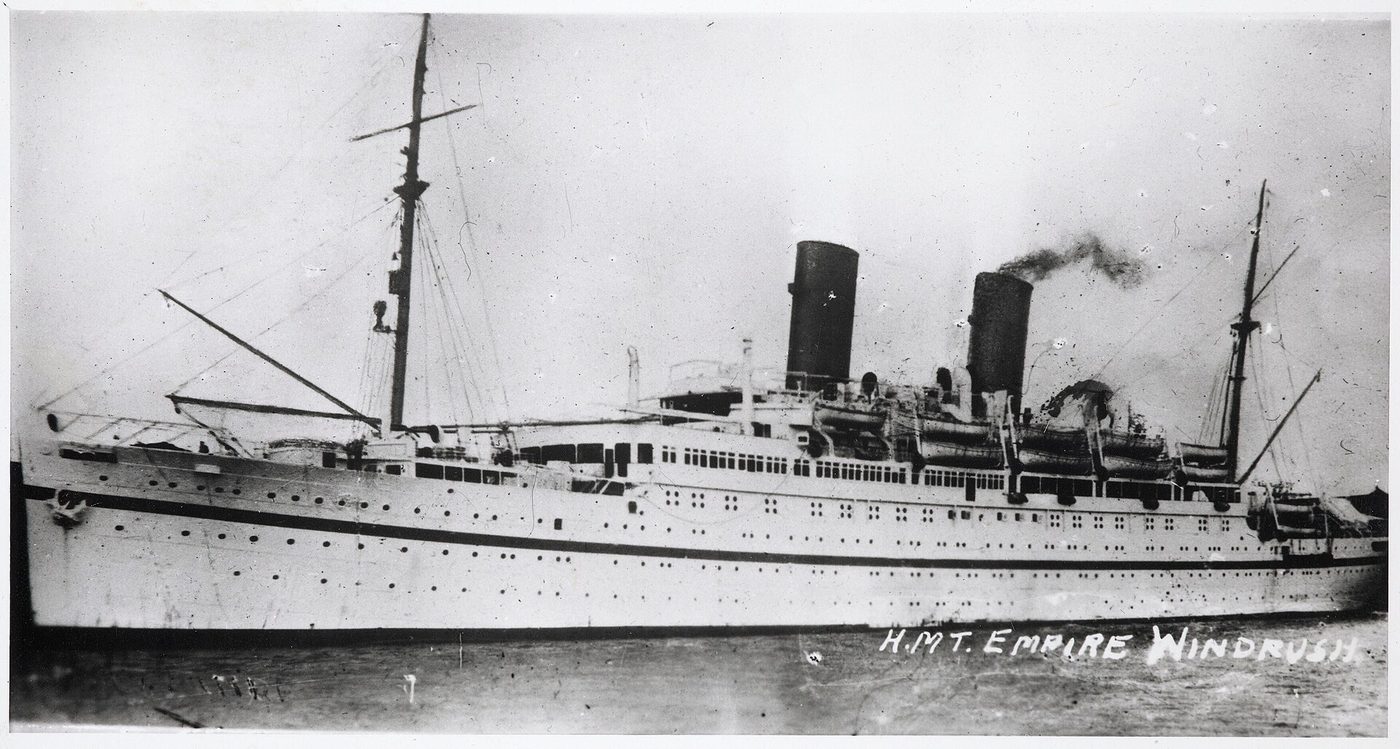

It lists the names of the 1,027 people (over 300 of them women) who arrived at Tilbury docks on 22 June 1948, a day now annually marked as ‘Windrush Day.’
The National Archives, “Postwar Caribbean migration”, about the Windrush passenger list
They would go on to play an invaluable role in rebuilding post-war Britain.
The National Archives
They were British citizens with the rights to enter, work and settle here if they wished.
The National Archives, “Bound for Britain”
Task 4 · Plato meets the news
Link each document from today to one extract from Plato. Write three sentences.
- The flags of 2025 remind me of Plato’s founding story because…
- For some people, the flags mean…; for others, they mean…
- The Windrush passengers came because Britain needed… This is what Plato means when he says that…
- The people who covered the mural with hearts were saying that…
- Getting out of the cave, for us, means…
Oral debate · 15 minutes
Can a flag belong to everyone?
There is no right answer, and we will not vote. Work in two circles: the inner circle speaks for 5 minutes, the outer circle listens and notes one idea it had not thought of. Then swap. Before answering someone, repeat their idea in your own words.
- If I understand you correctly, you think that…
- I see your point, but the document shows that…
- For the Weoley Warriors, the flag means…; for the charity in Bristol, …
- Plato would probably say that…
- The mural in Withington suggests that…
- I am not sure, because on the one hand…, on the other hand…
To finish, each student says one sentence: “Something I heard today that made me think is…”.
Gap-fill worksheet
 Gap-fill worksheet · Who gets to be English?Click to open, fill in on the screen and check, or print it · scan the QR code on a phone
Sources
- BBC News, “Marcus Rashford mural defaced after England Euro 2020 defeat”, 12 July 2021.
- BBC News, “Defaced Marcus Rashford mural covered in supportive notes”, 12 July 2021.
- BBC News, “Marcus Rashford mural graffiti ‘not racial’, say police”, 16 July 2021.
- Plato, The Republic, trans. Benjamin Jowett, Project Gutenberg eBook 1497 (public domain): Book II, 369b; Book III, 414b–415a; Book VII, 514a–515a.
- BBC News, “Why have thousands of St George’s flags gone up in cities and towns?”, 21 August 2025, updated 30 August 2025.
- The National Archives, “Postwar Caribbean migration” and “Bound for Britain”.
- Photos: Messages of support on the Marcus Rashford mural, Copson Street, Withington, Manchester, 13 July 2021 · Photo: Gerald England, CC BY-SA 2.0, via Wikimedia Commons (resized) · Mural by the street artist Akse P19 (2020), with Withington Walls. · The mural, covered with hearts, flags and notes, 13 July 2021 · Photo: Gerald England, CC BY-SA 2.0, via Wikimedia Commons (resized) · Mural by Akse P19. · HMT Empire Windrush · Photo: Royal Navy official photographer, public domain, via Wikimedia Commons (Imperial War Museums FL 9448, resized).

← Back to the learning journey Four Nations, One Kingdom?